
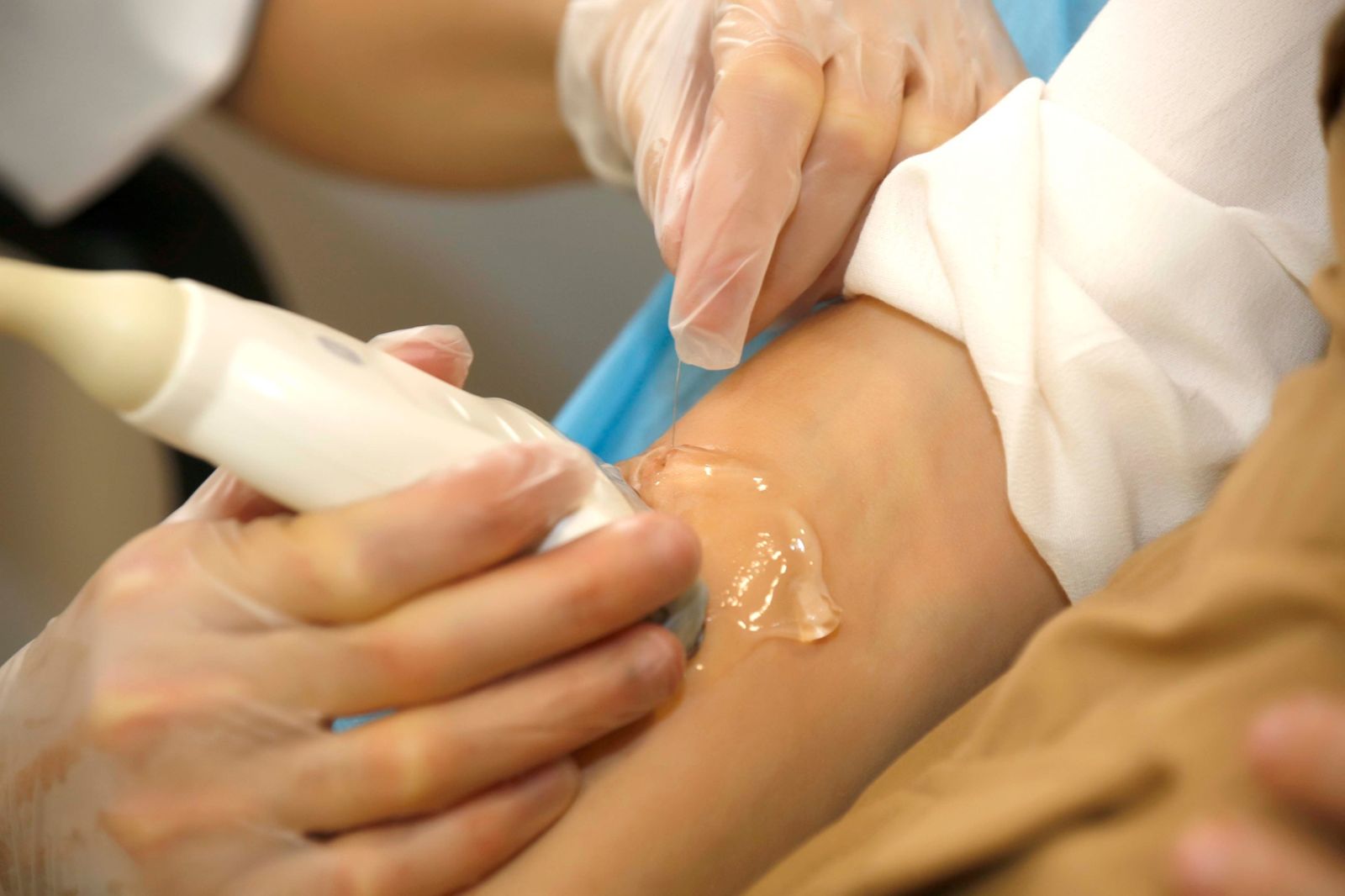
Ultrasound-guided invasive physiotherapy and ultrasound
At Hidrosalud we specialise in the latest techniques available to solve your problems as quickly and painlessly as possible.
1. Therapeutic percutaneous electrolysis
A technique for treating tendinopathies that applies galvanic current through an acupuncture needle directly to the damaged tissue. It is practically painless for the patient and allows fast, effective recovery.
At Hidrosalud we use the EPTE® System, the first percutaneous electrolysis device with medical CE marking, which guarantees that the technique is applied safely. Our professionals are trained in the technique and in its ultrasound-guided application.
2. Dry needling
An invasive technique for treating myofascial trigger points. It uses a fine needle similar to an acupuncture needle. It is called “dry” because no substance is injected into the muscle: it is the mechanical action of the needle itself that produces the therapeutic effects.
It should be combined with manual therapy, which enhances its effects. When indicated, results can be immediate, with a significant reduction in pain and/or improved movement.
3. Neuromodulation
A relatively recent technique that applies a low- or high-frequency TENS-type current percutaneously, through a needle, to achieve the effects of these currents beyond the skin barrier and act more directly on the nervous system.
It is performed under ultrasound guidance and the nerve itself is never punctured: the needle only needs to be placed close to it. It helps to:
- Relieve pain in acute conditions.
- Bring about changes in the central and peripheral nervous system in chronic pain.
- Stimulate the muscle to restore its activation pattern and improve motor control.
4. Electroacupuncture
A deep needling technique that applies electrical current through acupuncture needles to speed up regeneration and achieve greater relaxation of the affected muscles.
Goals
- Restore normal muscle length.
- Eliminate or relieve pain.
- Restore movement and myofascial activity.
- Prevent the injury from becoming chronic.
- Increase tissue relaxation.
- Improve motor control.
- Reach deep muscles that other techniques cannot reach.
Why electroacupuncture instead of dry needling?
Patients tolerate electroacupuncture better, with less post-needling soreness, and it increases the benefits of manual therapy.
Where is it used?
Muscles and tendons: myofascial syndrome (eliminating trigger points), fast and long-lasting muscle relaxation, and pain relief in tendinopathies such as epicondylitis.
Joints and ligaments: a sensory effect that reduces pain in conditions such as ankle or knee sprains, shortening rehabilitation, and improvement of the muscles around the joint, effective for hip and knee osteoarthritis.
Clinical indications
- Myofascial syndrome (quadratus lumborum, piriformis syndrome, psoas, etc.).
- Neck pain and low back pain.
- Tendinopathies (epicondylitis, subacromial syndrome, supraspinatus and other rotator cuff tendinitis, patellar tendinitis, Achilles tendinitis, etc.).
- Knee and ankle sprains.
- Hip and knee osteoarthritis.
- Tension headache.
Alongside electroacupuncture we use other treatments, such as radiofrequency, to enhance its effects and shorten recovery time.
“Ideally, both conservative and invasive treatment should be available to the patient on equal terms, so that either can be applied according to the indications.”
Book an appointment
We will get back to you as soon as possible by phone or email.